Freedom of Information Act
Making the public’s right to know easier to use: AI-powered FOIA search
The Freedom of Information Act gives every American the legal right to request records from their federal government. In practice, exercising that right has long required something most people don’t have: insider knowledge of how the federal government is organized.
The challenge
Exercising the legal right to public records required navigating a fragmented federal government without a roadmap.
The Freedom of Information Act gives every American the legal right to request records from their federal government. In practice, exercising that right has long required something most people don't have: insider knowledge of how the federal government is organized.
More than 100 federal agencies are subject to FOIA, and within them are hundreds of individual FOIA offices, each with its own intake process and none of them connected to the others. For a member of the public, that means the burden of figuring out where to ask came before they could even get an answer to what they were asking. Send a request to the wrong agency, and a person could wait weeks or months only to be told to start over somewhere else.
This is a problem that goes beyond any single request. FOIA exists to give citizens visibility into their government, but a visibility right only matters if people can actually use it. DOJ needed a way to meet people where they were: with a plain question, not a flowchart of agency jurisdictions.
The impact
- 50,000+People served in the first six months
- 10%Of all FOIA.gov visits within the first year
- 12,000Sessions ended in a click into a suggested document
Project at a glance
- Impact Areas
- Effective Government
- Capabilities
- AI/ML, Digital Product, Technology
- Tech Stack
- Custom ML Models, Drupal, React, USWDS
Deliverables
- AI/ML-powered FOIA search wizard
- Headless Drupal + React application
- Five machine learning models & term extraction datasets
- USWDS-compliant, Section 508 accessible design
- User research, journey mapping & usability testing
- Looker analytics dashboard & ongoing optimization
Our Approach
DOJ partnered with Forum One and Polydelta to build a new kind of front door to FOIA.gov
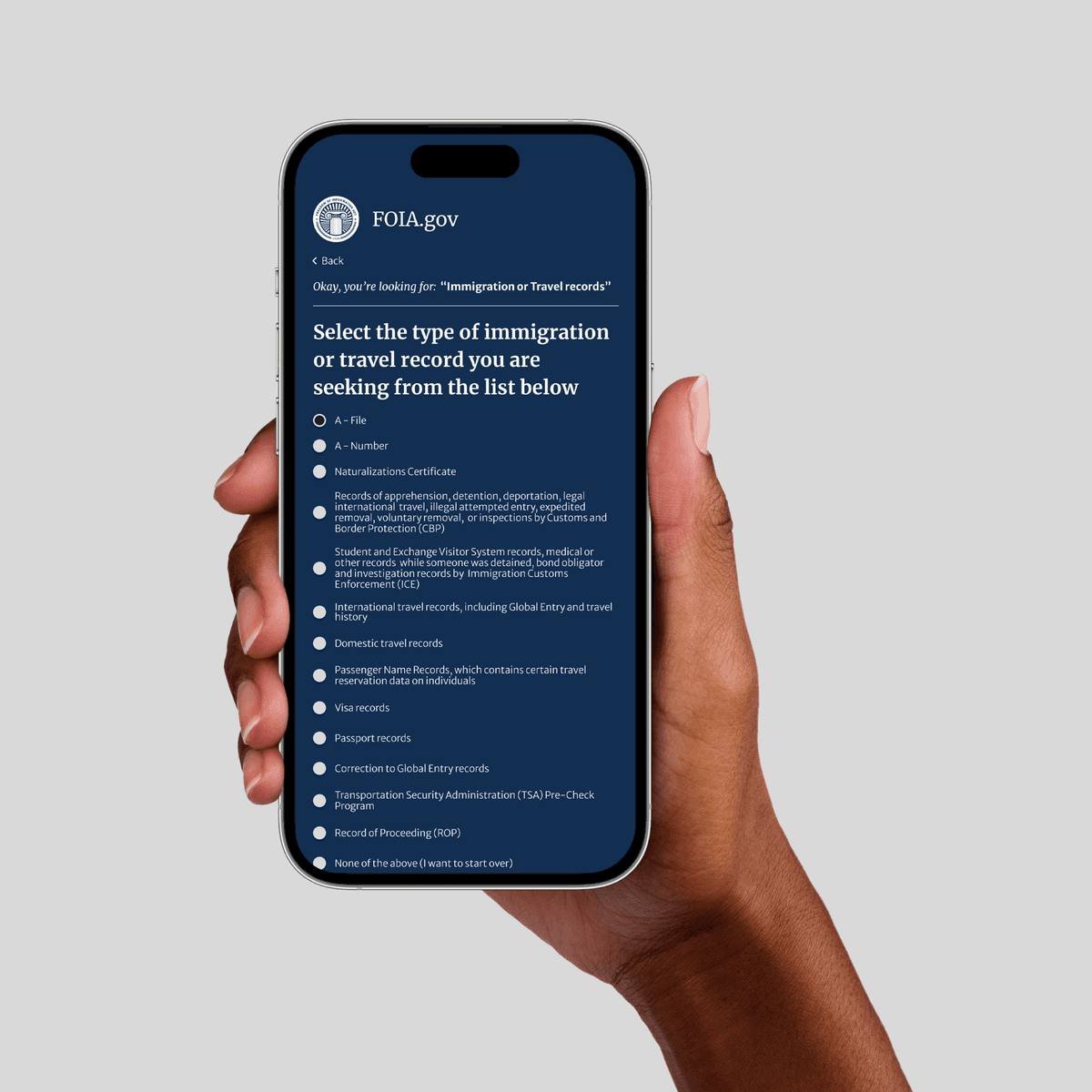
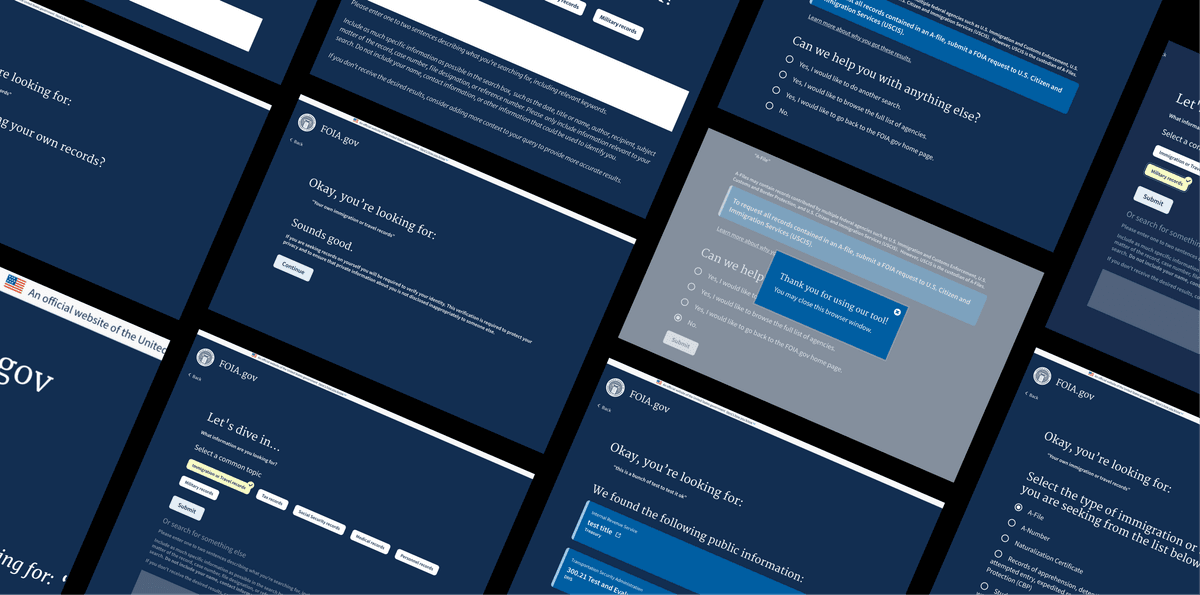
A conversational search wizard that lets people describe what they’re looking for in their own words, rather than requiring them to already know the right agency, office, or legal terminology.
We grounded the design in direct research with the people who'd actually use it. Working with subject matter experts across agencies, we mapped common user journeys and identified the handful of topics that make up the largest share of all FOIA requests. Those became guided, logic-based pathways: a person can select a common topic and answer a short series of questions that lead them to the right place, or search in their own words and let the system do the work of interpretation.
Under the hood, the tool runs on a decoupled web application: Drupal on the back end, React on the front end, connected via API, combining five machine learning models with string matching and rule-based logic to surface the most relevant results for each query. We built the experience inside FOIA.gov's existing design system, keeping it compliant with federal accessibility (Section 508) and usability standards, and engineered it to use query data only to improve the tool itself, never to identify individual users.

The Solution
The wizard changed what it feels like to ask the federal government a question. Instead of guessing which of dozens of possible offices to contact, a person can now describe what they need in plain language and get steered toward the right agency, or directly to records that are already public, no formal request required.


The numbers reflect how quickly people adopted it. In its first six months, the tool was used by over 50,000 people, with nearly 25,000 clicks through to completed search results. Within its first year, the wizard accounted for 10% of all visits to FOIA.gov, averaging 12,000 sessions a month, with 50,000 of those sessions ending in a click into a suggested document. DOJ has called it one of the most significant improvements to FOIA.gov since 2018.
That adoption matters for agencies too: every person routed to the right answer on their own is a request that didn't have to be misdirected, re-routed, or fielded by FOIA staff who would otherwise be doing that work by hand. But the deeper measure of impact is about who FOIA is supposed to serve. A law that gives people the right to know what their government is doing only works if exercising that right doesn't require already understanding how that government is structured. By turning a system built around agency jurisdictions into one built around the public's plain-language questions, the tool moves FOIA closer to what it was always meant to be: a right anyone can use.